Over the course of an extraordinary life, Vivien Goldman has managed to channel her talents into all kinds of incredible endeavors. Promoting Bob Marley at Island Records, making groundbreaking records under her own name and with groups like New Age Steppers, producing fearless music journalism and television programs. TP managed to track her down for a nice chat.
TP: Right, let's just fly into it. I've been doing a deep dive into what you’ve done—there’s lots of things I didn't know.
VG: I wanted to be a film script writer. And that is still what I'm working on. And one of the films that I wrote in the 80s, around the time I was doing music is about to be made, they say—hopefully, starting next year—and I'm working on another one now. But there was no film industry in the UK. And there was work writing about music. So that's why I started writing about music.
TP: So you were sort of doing reviews, but I mean, you had quite a famous career as a journalist, but you started writing about music, then moved into labels and then move back to the journalism.
VG: I was very into music. And singing was very natural for me, because my father is a musician, we always sang in the home. I used to always arrange the harmonies for my eldest sisters. And then I was a student at Warwick and, you know, music was good. We listened to the early Wailers and Miles Davis and the good music that was coming out of that time in the early 70s. So it was very easy for me to write about music. But in fact, I was more into film.
TP: When and how did you get the job with Chris Blackwell at Island Records?
VG: They scouted me. I was already working actually, I was a Londoner. After I left Warwick, I went home to my folks on Finchley road. They were giving away free magazines, and there was an ad to write about music. And that was how I started writing about music in a magazine that was an offshoot of Gramophone, which was a very venerable one. It was called Sets and Cartridges. And I got to know some people in the music world because I was writing about music.
I was previously at Transatlantic, which was a very, very interesting indie label run by Nat Joseph that I think doesn't really get enough props now for what it did. Actually it was like a folk and jazz label. And I did PR for amazing people like Flora Purim, McCoy Tyner, Richard Digance and various others. It was a great time with those indie labels, it was really a labour of love and Nat Joseph had his head screwed on right —he was a decent guy, and he loved the music. So I was there, and then I got headhunted by Island for a lot more money. I did like reggae, and that was when I really started working with reggae acts. I got the job to work with Bob Marley, Burning Spear, and Aswad.
VG: Bob had just left the others—Peter and Bunny—and was setting up a new thing, you know, with the I Threes and Family Man and all that. I was doing the press and they just didn't want to write about Bob. So the fact that I overcame it, I’m still quite chuffed. And Chris Blackwell was very chuffed. You know, I got Bob Marley on a lot of front covers because I loved the music, and also because I didn't really know the drill.
Like, I'm the punk Professor now and I was the punk PR then, learning on the job, you know, and that's why it's so funny, our paths. I’m still close to Chris today, which is amazing. He was my mentor into the business. It was a big help because he wasn't sexist and he wasn't antisemitic like many of the others were and I think that’s what helped me get my start.
TP: As far as writing about punk, you were obviously friends with the people and bands on the scene. I mean, was there any sort of fourth wall?
VG: There was no professionalism/fourth wall! No, nothing like that, everybody just lived together and work together. And I didn't think the musicians were better than me because they were musicians. And I was writing about them. I felt like I was an artist as a writer, too, you know, it was very egalitarian. There wasn't like loads of PR stopping people from seeing a person because they're so special. No, everybody was in it together with a mission. And those were heady days. And you can't really replicate them at will. Everybody now can have a go on the internet and stuff. So it's in a way levelled the playing field.
TP: If that's your outlook, then it was a very natural step to start writing lyrics as opposed to reviews…
VG: I was asked to do music just the same way. It’s like the whole thing of Revenge of the She-Punks, you know, I'd never seen women artists. I just hadn't made that conceptual leap until punk began, and other women came in and I just suddenly thought, yeah, I can do that, too.
TP: Right. Okay. And so when did you first step foot in a studio?
VG: Well, we had a studio at Island downstairs. Everybody who was on the label would go in there. And you know, they had it structured at the time in a very egalitarian way. So that everybody was sitting at round tables. And this view was still coming out of the 60s, that communal vibe. We hadn't gone into punk yet. It was amazing, really, because it was like a one stop shop. There was a studio downstairs. And then on the floor above, there was a cafeteria. And you could go and have your lunch there and everybody would be there. The musicians, the labour workers. That's nice.
TP: So when did you first visit a studio with a view to recording something?
VG: I think the first person to ever take me in the studio was Tyrone Downey of the Wailers for his solo album… I'm not sure, it's hard to remember, because soon after that I was doing back-up singing with Adrian Sherwood. You know, I'm a New Age Stepper. I'm on those Prince Far I albums and all that. And then I was in the Flying Lizards after that.
TP: So it I read somewhere that John Lydon took you in when they were recording Flowers of Romance.
VG: I've written a fair bit about that. And some that is in my anthology. What happened was, I was very close with Aswad, and George Obon [balearic heads will recall his post-Aswad deep cut "Basshoven" - ed], their bass player who was really brilliant. At that time, we all used tapes. So I had this thing where I had a couple of tape machines, I could record on one and then bounce onto another and do harmonies and on like that. And I had the song. And I took it to George—I wanted to do some more stuff. And he played me this baseline that is the “Launderette” baseline that was like—whoa, it's incredible. And I improvised the song right there to the baseline. So the whole thing just happened like that, just boom. It was a magical moment of creativity.
TP: I mean, was that a tale of what was happening to you at that time?
VG: No, not really. It was funny—it was just like a little movie. And then I made the video of it, which really is like a little movie. It's really sad, I wanted to be a filmmaker. And then in the 80s, I went and did television and made number of documentaries, and so on. I've got to get my YouTube together, because nobody knows what I did. I did a lot of TV work at a high level in the 80s.
TP: People might not know but Big World Cafe was quite an amazing show. I was watching one just now—the program runs from Kassav to Mory Kante, to Throwing Muses to Yazz. How did it come together?
VG: I made a production company with a guy I'd met doing stuff. And me and Eve, my partner in Chantage, who is living in England now. We had a radio show on Radio Nova, which was at that time a pirate. Jean-François Bizot was a big cultural guy who really changed the culture, and he was my boss. He was actually Eve's boyfriend at the time. We were both living kind of with him in his flat. And they were going a lot to Africa. Africa was very present in Paris. At that time, there was a lot of African musicians in the streets and so on. And me and Eve sang backup for an African band in Lingala, the melodious language of Zaire or was it Congo? Yeah. Yeah. Lingala is a very beautiful language.
TP: You did music documentaries as well?
VG: Yes, I did. I'm trying to get them put up on YouTube. I did a really good one for The Tube (brilliant Channel 4 music show) that I still have—I still have a CD of it—“Lagos Jump”. I think that Fela was in jail. I did a big one with the reggae Philharmonic Orchestra in Jamaica with Michael Riley, who's now done that 500 Years of Black British Music. I did other stuff as well. Our biggest thing was Big World Cafe because it was a series…
TP: So you know, interestingly, have things you’ve been involved in, being in the right place at the right time… Has that just happened purely by following your nose?
VG: The ears don't lie. And, you know, that's it. But I'm not really writing about music now. I was, and I realised there was a particular mix of music that I was so passionate about, having, as you see, stumbled into it accidentally. And there are aspects of that music in particular, that drew me in so intensely. Hanging around with people like Bob Marley, Ornette Coleman, you know, very inspirational people.
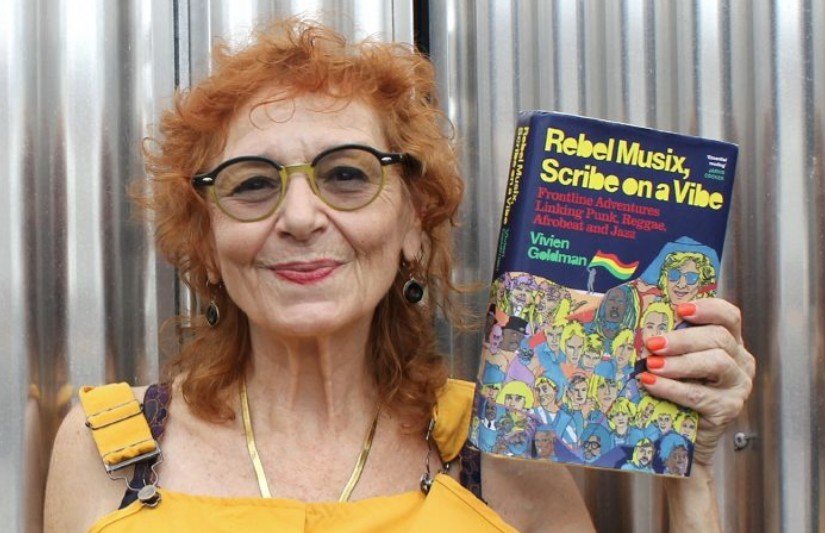
I called my anthology Rebel Musix, Scribe on a Vibe because I'm trying to reinvent myself now. We're trying to do some new things, some things that people don't normally do, right? Once I was talking to this very respected interviewer in Germany, and he started saying, “Well, of course, there's no good music now.” I exploded. I said, “Look, even if you don't know the good music now, you've just got to say it's my own fault. I don't know it because I'm not looking hard enough.” You can't just sit there all smug and say everything's good in the past.
The people of the record company were all listening to the interview in their office. And when I got back they were all like, yeah, Vivian, he's a boring old fart. And you, you know, it's true. So if I'm saying I don't see anything around me now that compels me and right draws me in, then it's my own fault.
I always felt that you’ve just got to have hope as a default mode. Otherwise, it’s hopeless.
TP: To your point—having great ears is a beautiful thing, but you kind of need to combine it with a fearlessness to achieve those things and be unafraid, whether it is standing in front of a microphone or directing a production of a TV show or running a magazine.
VG: I love you for saying that. Because you're just saying I'm fearless. Whereas in fact, I'm often crippled by fear, but I guess I'm fearless in another some other way because to me, it's because I came up with punk. So lucky.
TP: Is it that simple?
VG: Well, we had that DIY feeling— get up and do it. These people have been owning it and claiming it's their territory, and we can't get in because we're young and, or new or whatever. But we get up and we go, don't we? Isn't that what fires you?
TP: Well, we had acid house which had exactly the same feeling.
VG: Exactly. Sadly enough, I wrote a brilliant Acid House article for the Observer. I still remember the beginning of it. We were out in Tottenham Court Road. Everybody was dancing on top of the cars.
TP: You’re now working with Hat & Beard overseeing a series of books. What's the link between publishing and music?
VG: It’s rhythm, as well as why people need to go from one medium to another rhythm. I guess. That's what I always thought was at the heart of it in a way, but the word is my kind of main tool. But yeah, editing—whether editing a documentary, a video, or a book. It's all about what you do with it. It's all about the the finessing, the editing, the rhythm, whichever medium you're in, whether it's the music, same is true of music. I say Word Sound and Power like Peter [Tosh]…
When my agent was first talking to people about my anthology in England, they loved it. And there was like a bidding war, right, who was going to win? And in America, they were just perplexed, and they said, We don't understand this book. It's about so many different types of music. Big World Cafe was eclectic. I've always been about unification. I'm trying to make people understand each other more really… To be honest. I look at the whole world to get an analysis. That's just how I like to look at things. It's just perspective.
TP: Well, you know it's like this welcoming thing to collaborate and work—for me, life is about collaboration.
VG: When it's a collaboration, usually at some point, one or at the very most two, have to be able to pull the switch and say yes or no.
TP: I do agree. Because you see it with bands. If a band is a co-op, generally, you still need someone at the front of it, someone who understands the workings of a co-op.
VG: Everyone has to respect them, they have to have that integrity.
TP: I was just reading Trevor Horn’s autobiography…
VG: Everybody's doing them, aren't they? Yeah, he's really good. Actually, super entertaining. Do you think he wrote to himself, or did he do a co-write?
TP: No, it totally is him, I think. The beautiful thing about it that struck me was that he's clearly a man that's made an awful lot of money. So he doesn't feel the need to hold back or be unafraid of his own opinions. My point was that he was talking about Belle and Sebastian, the Scottish band—he was producing them. And he said they were a co-op with a leader, which works perfectly.
VG: Ah, yeah, you just don't want them to go like you know, Uncle Joe Stalin.
TP: I think the thing that punk had massively in common with acid house was that it was an attitude. I mean, it was a musical form as well. Everyone gets the musical form.
VG: Throwback punk to an extent, right?
TP: I was wanting to ask you—did you know Fela well? How did you end up going to Lagos?
VG: Fela was in jail at the time. I was making a documentary for Channel Four, actually was for The Tube to try and push for his release. But before that, I worked with him in Europe. As you know, I'm doing this book. I'm still in touch with the kids, Yeni particularly. Yeni is incredible. I love that family. They accepted me and I felt part of them.
I’ve always been about unification. I’m trying to make people understand each other more, really.
TP: What are you up to now…Aren’t you doing sort of private courses now or something?
VG: I've been teaching at NYU. And then at Rutgers, I've taught writing, you know, music journalism. And basically, I'd been living in Jamaica, and I wanted to do more work online. And it was great when I was teaching NYU online, but they all want you to be there live now. So you know, I was thinking, What should I do? And I was kicking it around with friends. And we thought, well, wouldn't it be great to teach writing online. Maybe if I do this for a while, I can then graduate to giving more general one-size-fits-all. But right now I'm really offering a boutique service.
TP: So people can find out on your website, basically, and then get in touch with you…
VG: One of my first students, she was really into poetry. And I was like—are you sure you want me? Because I'm not a poet, although I’m a lyricist. And I know I did help her a lot. This was my cunning plan, and I wanted to give it a go. I found I really liked the online teaching. You could sit around in your pyjama bottoms, nobody knows. Hello, young person. Not that young, but thank you!
TP: They're there. They're unafraid. And they're there. They're the good ones. Once they're there, we'll be alright, when the young ones come through.
VG: You know, it's nice to think that but don't forget, the young ones are just a reflection of the society we're in at the time. When the kids were saying to me, what's a demo, you know—they don't know everything—and they didn't want at that moment to go out and demonstrate because they wanted to have a clean record for when they got went out and got their codeword job. Not all youth are the same. But we like to think that what you just said is what we subscribe to. And it's what Bob thought.
TP: You know, like my mum finds finds hope in Jesus and Christianity, but I find hope in young people, maybe that's it, you know?
VG: That's an interesting point. I find hope just because I believe that you have to have hope. That's why I became a Buddhist, I think because they felt like me. But I always felt that you've just got to have hope as a default mode. Otherwise, it's hopeless.
TP: You’re over in Jamaica a lot now. I went to stay once at Jon’s, the guy who ran Gee St…
VG: You didn't stay with Jon Baker? Our man in Jamaica?
TP: He's a good dude. I liked him.
VG: I used to work with him. You know. It was tough for him.
TP: We went from Portland to Kingston and someone took us to the Asylum which was the big club at the time. And I've never seen anything like it. I was like, this is the best club I've ever been to by a mile.
VG: Jamaica is incredible. Jamaica is like it says on the box, so culturally different from other Caribbean islands. And you can be like literally on the top of a mountain in the middle of nowhere in Jamaica, and there will be all- night raves in the village. And that's how they came to England and kickstarted so much. People resented it because racists resented it. But you know, for the majority of the people, it's a bloody good thing they came. Did you realise the Morris dancers—it’s actually derived from Africa. Really Afro-Celt, you've heard of Afro-Celt, remember, like Simon had Afro CELT sound system, but it's real thing. The Moors really conquered a lot of places, and they've left traces. And what I noticed was having seen a lot of Senegalese dancing and then looking at some Morris dancing, and it all came together, I realised it's Moorish dancing. Because a lot of the steps are very more simple and less energetic, but they're just Senegalese steps. I call it dancing, no dancing. I love how you can see how everything connects together.
TP: That’s a positive place to end… Thanks for your time!
VG: You’re welcome.
Get in touch with Vivien through her website HERE
Vivien is on Bandcamp, check her back catalogue HERE
The Black Chord is out NOW from Hat & Beard Press